Easy Toddler Fall Sensory Bin Idea
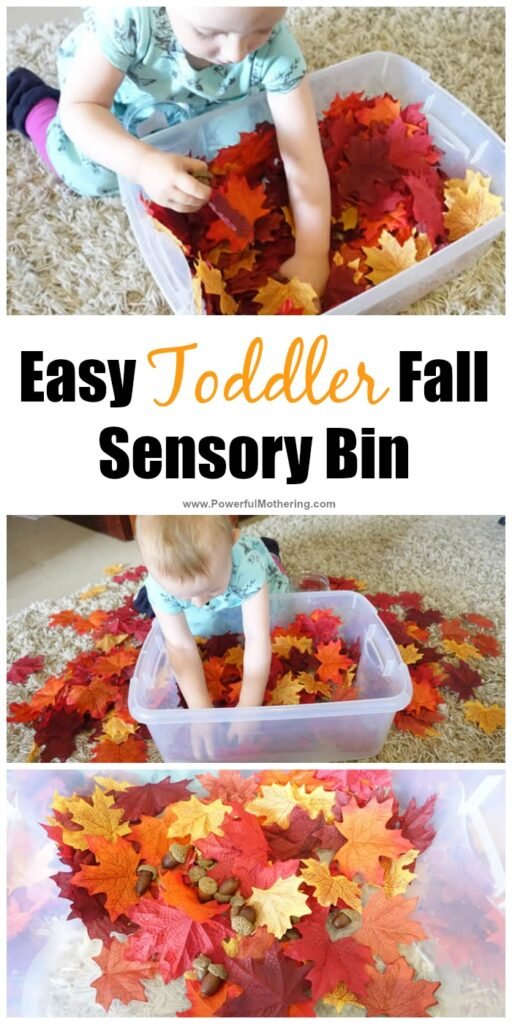
I just love the colors of fall, all those orange, yellow and reds! Today my toddler was looking for something different to do so I pulled out a few leaves and some acorns for her sensory bin.
Heads up: this post may include affiliate links. If you make a purchase, I may earn a small commission at no extra cost to you. Learn more in my disclosure.
This fall sensory bin for toddlers takes about 5 minutes to set up. All you need is a tub, some leaves, and a handful of acorns. It’s a hide-and-find game that builds fine motor skills, sorting, and early language, and it’s perfect for a quick autumn activity at home or in the classroom.
At a glance
- Best for ages 18 months – 3 years
- Prep time 5 minutes
- Play time 15–30 minutes
- Mess level Low to medium (leaves will escape)
- Skills Fine motor, sensory, sorting, early maths, language
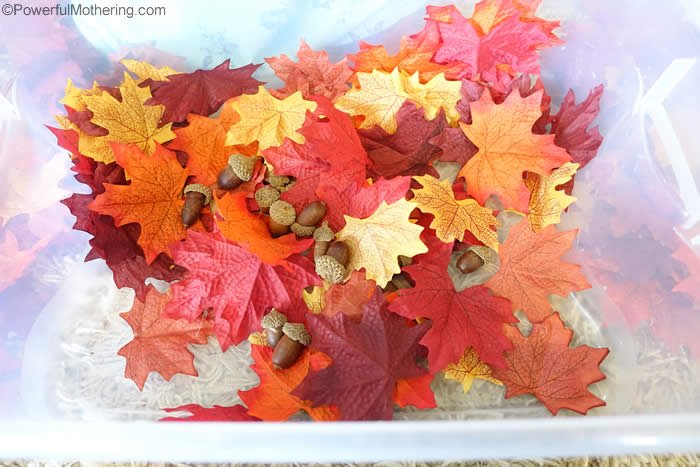
Materials needed for a fall leaf sensory bin:
The “two paths” format: what you probably have at home, plus a shortcut for busy parents.
- Leaves: real leaves from the garden work perfectly.
- Acorns / other objects: acorns, small pine cones or conkers. Or try these wooden acorns, which are larger and easier to hold. (If you are worried about small pieces for your child, choose a larger object.)
- Sensory bin: any storage tub, baking tray or washing-up bowl. Or this sensory bin with a lid for easy storage.
- Extra container to sort in: a bowl, egg carton or muffin tin.
- Optional: toddler tongs or scoops and a splash mat to catch escaping leaves.
Busy Parent Shortcut
No time to gather supplies? Here’s everything we’d use, in one go:
Faux fall leaves · Wooden acorns · Sensory bin with lid · Toddler tongs · Splash mat
How to set up your fall sensory bin
- Fill the bin about halfway with leaves.
- Show your toddler the acorns first, so they know what they’re looking for.
- Hide the acorns in the leaves while they watch.
- Put the empty sorting container next to the bin and let them find the acorns.
How we played
My little one was most pleased with her colorful sensory bin! At 23 months old, she loves to pack stuff into any available container. This was right up her alley.
First I showed her the acorns, then put them into the sensory bin full of leaves. She was very curious as to what was happening! THEN she went digging to return them to the sorting container.
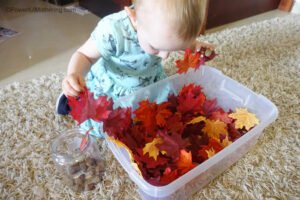
More digging in the leaves for acorns.
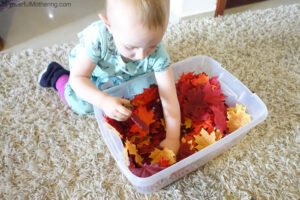
Word of warning 🙂 Leaves will escape. lol
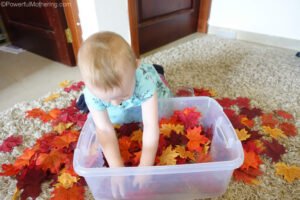
She removed half the leaves to make the acorns easier to find.
Skills this fall sensory bin builds
- Fine motor skills: picking up acorns builds the pincer grasp (thumb and finger) needed later for holding a pencil.
- Sensory exploration: crunchy, crinkly and smooth textures help toddlers process touch and sound.
- Problem solving: searching for hidden objects builds object permanence and persistence (just like when she removed half the leaves to find the acorns faster).
- Sorting and early maths: moving acorns from one container to another is the first step towards sorting, counting and one-to-one matching.
- Language: a natural chance for words like crunchy, under, in, out, more and colour names.
- Focus and independent play: a simple, open-ended task that toddlers can repeat again and again.
Safety Tips
- Acorns and small objects are a choking hazard for children under 3. Always supervise closely, or swap in larger items like big pine cones or wooden acorns for younger toddlers.
- Remove acorn caps if they come loose.
- If you use real leaves, shake and dry them first, and check for bugs, mould and sharp stems.
- Pack away the bin when play time ends.
How to adapt this activity (ages 1–7)
- Ages 1–2: use fewer, larger items and a shallow tray. Focus on “in” and “out”.
- Ages 2–3: add tongs or a scoop for extra fine motor practice.
- Ages 3–5: sort leaves by colour, count acorns into a muffin tin, or hide number or letter cards in the leaves.
- Ages 5–7: make a simple “leaf graph” by colour, measure leaves, or write fall words in a nature journal.
- Sensory-sensitive children: start with faux leaves (softer and quieter) and offer tongs so they don’t have to touch with their hands.
- Sensory-seeking children: add dry, extra-crunchy leaves or a few cinnamon sticks for scent.
- Classroom or groups: set up 2–3 smaller trays so children can take turns without waiting.
Ways to extend the play
- Read a fall book afterwards, such as Leaf Man by Lois Ehlert, or We’re Going on a Leaf Hunt.
- Go on a nature walk to collect your own leaves for the bin.
- Turn the leaves into a craft: leaf rubbings or a leaf collage.
- Swap the acorns for mini pumpkins or pine cones the following week.
Our fall sensory leaf bin for toddlers:
I also took a little video! I love action shots 😀 Watch her dig for acorns and sort them into the container in this 1-minute video.
Fall sensory bin FAQs
What do you put in a fall sensory bin for toddlers?
Leaves, acorns, pine cones, mini pumpkins, cinnamon sticks or dried corn. Start with 2–3 items so it’s not overwhelming.
What age is a fall sensory bin good for?
Toddlers from about 18 months love the hide-and-find part. Older preschoolers (3–5) can sort, count and use tongs, and children up to 7 can use it for maths and nature journalling.
Are acorns safe for toddlers?
Acorns are small enough to be a choking hazard for children under 3, so supervise closely or use larger wooden acorns or pine cones.
How do I keep the mess under control?
Put the bin on a splash mat, old sheet or towel, and only add a few leaves at a time. Some leaves will still escape.
More fall activities you’ll love